Complex Mode Shapes
The mode shapes of turbomachinery blades can be complex if there is significant structural coupling due to blade connections such as tip shrouds or snubbers. The plot below shows how the blade connections cause the blade mode shape to have both bending and torsion components at different phases. These complex modes can be either forward running (same direction as turbine rotation) or backward running (opposite direction).

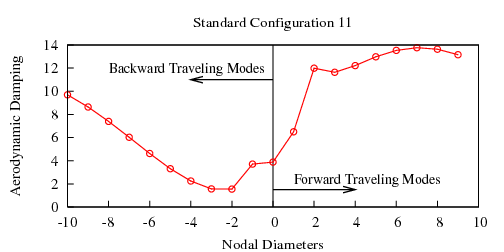
RPMTurbo can perform flutter analysis on turbomachinery blades with complex mode shapes. Complex numbers are used to represent the mode shape, for example in the mode shown above, the real component would be the axial bending and the imaginary component would be the torsion. The three-dimensional mode shapes (real and imaginary) calculated via a finite element method are interpolated to a three-dimensional CFD mesh. The unsteady flow response is calculated by RPMTurbo's linearised flow solver and then the flutter risk is determined. The plot below shows the aerodynamic damping calculated due to forward and backward running complex modes for the Standard Configuration 11 turbine profile.