
Blade flutter is the self-excited vibration of a blade, due to the interaction of structural-dynamic and aerodynamic forces. It is a significant problem for the manufacturers of large-scale turbomachinery such as gas turbines, steam turbines and aircraft engines. It can lead to dramatic blade loss in the short-term and high-cycle fatigue (HCF) in the long-term.
For most turbomachinery cases, the structural forces dominate and the aerodynamic forces can be neglected when calculating the blade mode shapes. The blade mode shapes can be determined by standard FE analysis. The flutter risk is assessed by calculating the unsteady flow response to the blade mode shapes. The aerodynamic damping can be calculated from the unsteady flow response and it is a measure of the amount of work done by the unsteady aerodynamic forces on the blade. The aerodynamic damping is calculated at various inter-blade phase angles to account for the aerodynamic coupling between the blades. A negative aerodynamic damping denotes that the blade motion is aerodynamically unstable, that is the unsteady aerodynamic forces are doing positive work on the blade. This can lead to a flutter problem if there is insufficient mechanical damping.
The most difficult and computationally expensive component of flutter prediction is the determination of unsteady aerodynamic forces. Flutter usually occurs at off-design operating conditions where flow separation occurs, for example, stall flutter and choke flutter. 3D viscous flow modeling is necessary to predict accurately separated flow. In the past, 3D unsteady viscous flow modeling has been too computationally expensive to use during the design phase. Manufacturers have had to rely on simplified flow models (e.g. 2D inviscid), reduced order models and empirical data during the design process. It has been shown that simplified models and emperical data fail to capture the physics of unsteady flow, and hence have a limited range of applicability. However, due to the continuing development of numerical methods and the constant increase in the speed and memory of computer hardware, it is now possible to perform 3D viscous flutter analysis during the design phase.
Below is an example of a 3D viscous flutter analysis of a compressor blade. The plot on the right shows the aerodynamic damping for a blade torsion mode for various flow models: 2D viscous, 3D inviscid and 3D viscous. The results of the 3D viscous analysis are significantly different from the 3D inviscid and 2D viscous analyses with the 3D viscous model predicting some unstable cases while the other flow models predict that all cases are stable. The reason for the difference is the presence of corner separation near the hub and suction surface of the blade. The corner separation can be seen in the figure below (left) of a contour slice of flow Mach number at ten percent blade height. The corner separation is only captured by the 3D viscous simulations. This highlights the importance of 3D viscous effects on flutter.
Early identification of potential flutter problems can have significant economic benefits:
It has been estimated that 30 percent of overall development costs of jet engines is due to high-cycle fatigue (HCF) management and that each new jet engine development has on average 2.5 HCF problems, which lead to considerable time delays and cost overruns. Delays in development for a medium-size 500 MW power plant can lead to a loss of revenue up to 2.5 million US dollars per week.
The flutter analysis process as performed by RPMTurbo is shown below. A customer has a preliminary design (turbomachinery blade) and wishes to know the flutter risk of various blade mode shapes at various operating conditions.
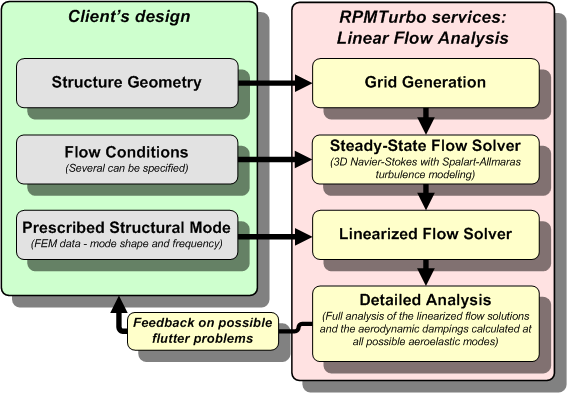
RPMTurbo has developed a 3D linearized Navier-Stokes flow solver to calculate the unsteady flow response due to blade motion. The main features of RPMTurbo's linearized flow solver are:
To perform the calculations, RPMTurbo uses a 180 dual-processor AMD Opteron distributed parallel computing cluster with 720Gb of distributed memory.
Previously, 3D unsteady viscous flow simulations were only performed for research purposes. RPMTurbo has developed a linearized flow solver that is capable of performing a 3D viscous unsteady flow simulation in 20 minutes. RPMTurbo can complete a full 3D viscous flutter analysis involving hundreds and even thousands of unsteady flow simulations in a short time-frame (weeks not months) that is acceptable to the design engineer. As a result, 3D viscous flutter analysis can play a role in the design process and result in a significant economic benefit for manufacturers due to reduced development costs and reduced losses due to development delays.
The mode shapes of turbomachinery blades that have significant structural coupling (flexible disk, shrouded blades, and/or blades tied together) can be complex. RPMTurbo's linearized flow solver can determine the unsteady flow response due to complex mode shapes.
Flutter maps are contour plots of the aerodynamic damping as a function of operating condition for a given mode shape and frequency. Over 200 operating points are plotted on each flutter map. The flutter maps clearly show the flutter boundary due to the large number of operating points on the map. Flutter maps can be used by design engineers to determine the flutter margin (flutter margin is the difference between the operating envelope and the flutter boundary).